
When upper school students returned to the hallways this fall, many noticed a change right away. The unmistakable glow of screens lighting up students’ faces had disappeared. There were no phones in sight.
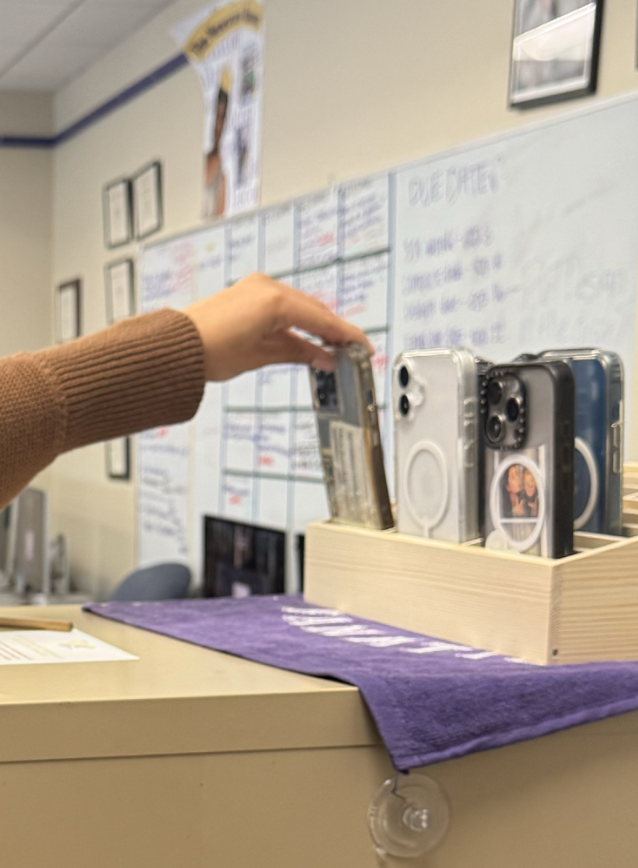
Under the school’s newly implemented phone policy, students are no longer permitted to have their phones outside their backpacks in the Upper School building, along with having them locked away in wooden cases at the beginning of each period, a notable shift from last year’s much more relaxed rules.
The school’s administration says the decision was driven by a desire to act in the best interest of students. With research increasingly linking phone use to stress and anxiety, the hope is that phone-free classrooms and hallways will encourage more face-to-face conversation, greater focus in class, and healthier breaks between periods.
“As a means to help support our students’ wellbeing, The Kinkaid School is adopting Divisional smart-device policies supported by current research and in alignment with other independent schools,” said Ms. Spencer in an email to the Upper School student body.
Not everyone is convinced the change is entirely positive. For some students, the loss of immediate phone access raises safety concerns.
“If there is an emergency, and I need to reach my parents or someone to help right away, I can’t,” said sophomore Gabby Chastain. “I understand not having phones out in class, but banning them in the hallways seems unnecessary.”
Still, not everyone views the change so negatively. For some students, the absence of phones has made the hallways more lively and social.
“I’ve noticed people actually talking between classes instead of just scrolling,” said junior Alexia Hoffman.
Upper School history teacher, Mrs. Angela Wainright, shares in the sentiment, adding that the new rules have made it easier for students to stay engaged. “Students have told me they feel like they are focusing more and are less distracted.”
In fact, many freshmen see the Upper School policy as a breath of fresh air, compared to the much stricter one in the Middle School.
“I actually don’t mind the Upper School phone policy. It’s much more lenient than the one we had in 8th grade, and I think the one we have here creates a good balance,” said freshman Isabella Petree.
Despite the clear positives, the debate raises a larger question: should schools restrict technology, or should they teach students how to use it responsibly? Completely eliminating phones from learning spaces may reduce distractions in the short term, but some wonder if it does much to prepare students for the challenges of balancing screen time in college, the workplace, and daily life. Setting aside phone-free zones in academic spaces, such as classrooms, while allowing responsible use during breaks, may offer a healthier compromise.
The new phone policy has certainly reshaped the daily experience of the Upper School in a way that extends beyond convenience. While disagreements are still prevalent, it is clear that the school’s decision has encouraged meaningful conversations about what it means to build a connected, mindful community in an increasingly digital world.
“It will definitely take time to adjust, but in the end, I think this policy is teaching us to be more present in the moment,” said Hoffman. “That’s a skill we will carry with us long after high school.”