
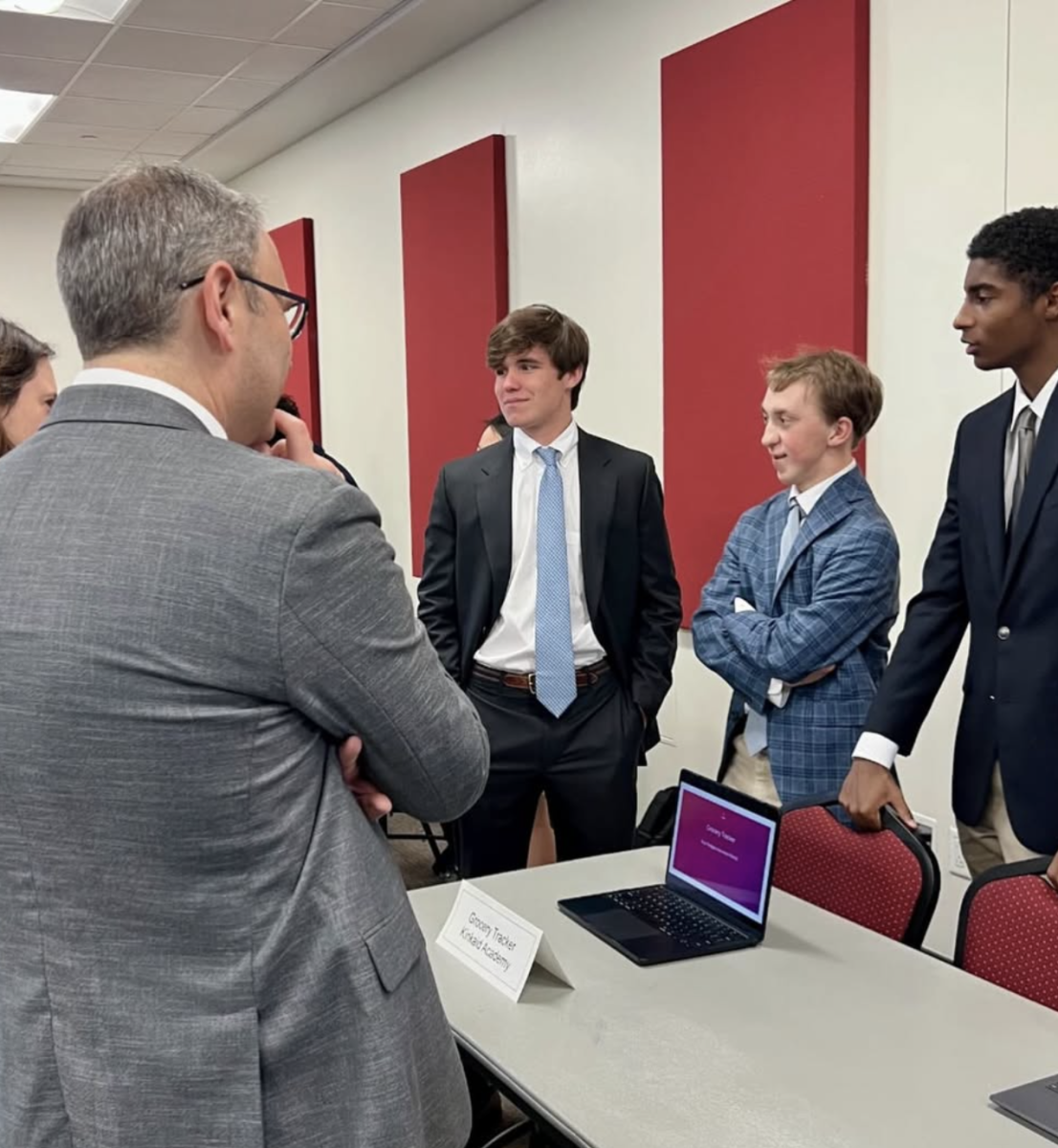
Students in Kinkaid’s Incubator Entrepreneurship course traveled to the University of Houston to pitch their minimum viable product to faculty and mentors from one of the nation’s top-ranked undergraduate entrepreneurship programs.
The visit marked the first major external pitch opportunity of the year for the class, giving students the chance to test their ideas in front of third-party evaluators at UH and receive feedback from experienced innovators.
Chew Crew, a durable and custom-fitted mouthguard designed by junior Baird Snyder and seniors Tanner Nyveen and Evan Rohde, was one of the product ideas. They created their product to address the rapid deterioration of traditional mouthguards, a common frustration among athletes.
Typical off-the-shelf models cost around $35, but the team argues athletes often end up replacing them throughout the season due to tearing, chewing, or general wear. Chew Crew, priced at $40, offers a custom fit molded specifically to an athlete’s teeth and is made from a stronger and safer plastic formulated to withstand months of heavy use.
“We kept hearing the same thing from athletes, that their mouthguards do not last,” Snyder said. “Ours is only a few dollars more, but it fits better, it’s much healthier and it actually lasts an entire season.”
During the UH pitch, the group outlined its target market, manufacturing options and potential partnerships with local dentists and club sports programs. Their cost and durability comparison chart drew interest from several UH mentors, who questioned the team on scalability and distribution but praised the clarity of their value proposition.
Snyder said presenting the product to an outside audience was one of the most valuable parts of the experience.
“I thought it was good to experience how to pitch in front of random people, and thought it could be an important life skill one day if pitching in front of a board of investors for a business,” he said.
UH’s entrepreneurship program, consistently ranked among the top in the country, hosts visits each year for high school innovators. Students in the program believe that early exposure to real-world pitch environments helps sharpen their communication skills and understanding of the competitiveness of startup culture.
For Kinkaid students, the event also serves as preparation for the school’s pitch night in the spring, where teams present refined business models to a panel of judges and investors. Feedback from UH mentors will guide the next phase of development, which includes testing prototypes, analyzing production feasibility, and gathering user responses.
The Incubator course, modeled after collegiate entrepreneurship frameworks, guides students through the process of identifying a problem, developing a solution, and building a working prototype.
For many, the UH pitch event served as a big milestone. This was the first time their concepts were evaluated outside the supportive walls of the classroom.
As the semester continues, teams will move from basic prototypes to more advanced MVP testing.
For Snyder, Nyveen, and Rohde, the goal is straightforward: ensure their final product delivers on the durability and safety promised in their early pitch and prove there is a real market for a better mouth guard.