
Since large language models (LLMs) were first made widely available to the public in the 2020s with the introduction of ChatGPT and a variety of other generative artificial intelligence (genAI) models, AI has quickly solidified its role as an integral part of society and industry. And now, AI is creeping into a field long thought to be an immensely creative and uniquely human endeavor: film.
Screenwriters were the first to feel the impact of genAI’s influence. In 2023, the Writers Guild of America, representing 11,500 screenwriters, went on strike for 148 days over disputes with the Alliance of Motion Picture and Television Producers. One of the main issues? AI. Screenwriters, fearing the lowering of pay and removal of jobs due to the capabilities of AI, demanded limits on its utilization.
And movie creation in general is already in the process of being dehumanized. Hollywood films like “Top Gun: Maverick”, “The Irishman”, and “Avengers: Infinity War” have used AI to synthesize accents and voices, de-age the actors, and to create higher-quality CGI animations.
Those in the industry hold varying opinions on AI and its future.
Many continue to worry about its influence on jobs and the diminishing of creativity. According to an article by The Hollywood Portal, Tyler Perry, acclaimed actor, director, and filmmaker, recently halted an $800 million expansion of his Atlanta studio after seeing the capabilities of OpenAI’s Sora.
“There’s got to be some sort of regulations in order to protect us. If not, I just don’t see how we survive.” he said. “In the near future, a lot of jobs are going to be lost.”
Furthermore, in May of 2025, Dutch actress and producer Eline Van der Velden created and launched Tilly Norwood, an artificially generated character who sparked debate and fury among actors and fans of Hollywood.
In a recent article by Variety, Emily Blunt voiced her growing concern over the rise of Norwood, describing it as a frightening threat to the acting community. She emphasized the importance of genuine human interaction in performance, pleading with agencies to “stop taking away…human connection,” highlighting how artificial tools risk destroying the human presence that makes the art of acting beautiful.
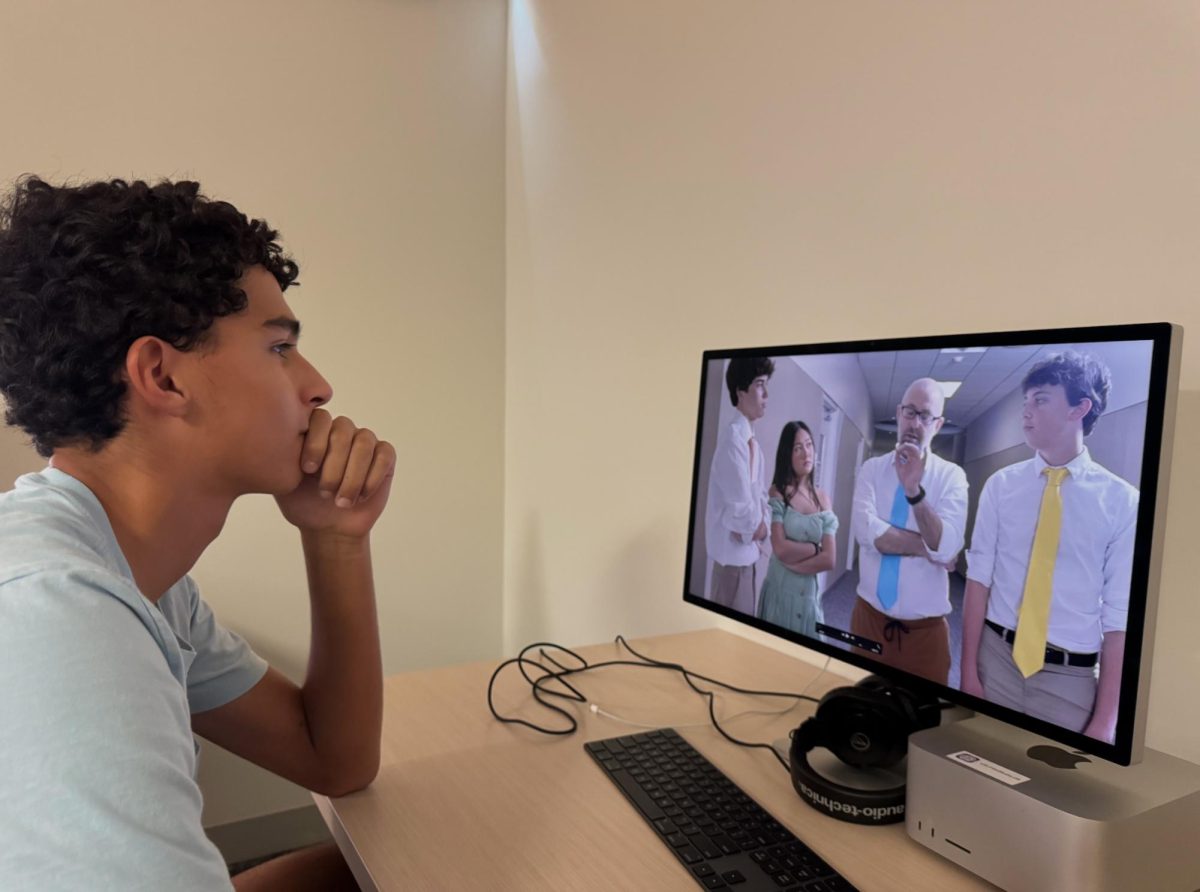
Kinkaid’s film teacher, Mr. Ryan Gillentine, shared a similar perspective on how AI can undermine students’ talent and authenticity when it comes to their work. He explains how he prevents this problem among upper school students.
“I don’t allow AI in my classroom; it can’t write or edit for you… and it undermines the human perspective in the art,” he said.
Mr. Gillentine further criticizes the use of AI within film in general, citing the moral issue of AI being trained on the works of others.
“You’re using other people’s material without their express permission,” he said. “There’s a reason why, you know, you can get AI to write a script like Quentin Tarantino. And it’s because someone has taken Quentin Tarantino’s intellectual property in that all of his scripts are embedded into an AI.”
Moreover, for Mr. Gillentine, AI’s inability to express and feel human emotion is another issue that should warrant caution against its use in the industry. Praising the classic movie “Elf” for its “crafted and smart and thoughtful” and “unique” take on the “human condition,” he emphasized that AI “cannot” replicate the same humanity. “It’s not human.”
Others, however, are more willing to use the technology. In an article by The Guardian, Robert Zemeckis, director of the upcoming film “Here,” supports his decision to use Metaphysic’s (an AI firm) face replacement tech AI to de-age the stars.
“The film simply wouldn’t work without our actors seamlessly transforming into younger versions of themselves. Metaphysic’s AI tools do exactly that, in ways that were previously impossible!”
In the same article, Jim Geduldick, VFX supervisor and cinematographer for “Here” shares another perspective about AI’s benefits and preserving artists’ creativity: along with speeding up the “business and the creative side” of their work, AI also doesn’t pose a huge threat to human imagination.
“There is no generative model out there today that doesn’t get touched by artistic hands to get it to the next level,” he said.
No matter the outlook on AI’s burgeoning influence, it remains a fact that the technology will continue to grow in the near future. Whether it will take the jobs and humanity from people or act only to optimize the filmmaking process while keeping that key human component remains to be seen.